Diana's boundary for reconciliation
Falling For The CEO: BAD BOY ROMANCEDiana's boundary for reconciliation is the condition that William must work through the unresolved trauma of his marriage to Julia before he and Diana can be together again. Although Diana loves him and wants to remain with him, she refuses to let their renewed relationship become a repetition of the old one, in which William's fear of betrayal could make him treat her as though she were Julia. Her demand gives emotional reconciliation an ethical requirement: love may survive the injury, but it cannot simply skip over it.
Origins in Secrecy and Fear
Diana's condition develops out of the earlier concealment that damaged her relationship with William. She had told him that she was a tour guide without saying that the work was at the hotel where he was her brother Connor's employer. Her distinction was technically accurate, but she understood that withholding the crucial setting allowed William to form a mistaken impression. She explained that she had been afraid he would think she had deliberately misled him, and that she had not planned the relationship as a way to prevent him from firing her. Instead, she had become involved with him after they were trapped together in an elevator and had panicked when she discovered who he was.
The concealment also reflected Diana's wider fear of instability. After the car crash that killed her parents, Cora Jones and Derek Jones, she fell into a severe depression, lost a university scholarship, and abandoned her return to university. Connor forced her to come to work at the hotel, and the job gradually gave her a way back into ordinary life. She began by assisting guests, then developed popular tours of Cape Town, researching the city's history and culture until work became a form of recovery rather than mere survival. Her fear that employment could be taken from her therefore carried more than a professional consequence. When she argued with Connor that she could not keep asking him to save her and might have to face being laid off on her own, she revealed why she had tried to protect herself from William's judgment and from the possible collapse of the life she had rebuilt.
The Boundary Stated
Diana first apologizes directly for the concealment, acknowledging that she lied and hurt William even though her purpose had been to protect herself from being hurt. William's response is not limited to the factual omission. He tells her that he no longer knows whether the person he fell for is real, reducing the conflict to a crisis of identity and trust. Diana insists that she remains herself, but his inability to separate her from the deception shows how quickly the injury has altered his perception of her.
William later asks Diana to start over with him, explicitly wanting a relationship without the lie between them. The request marks a movement toward reconciliation, but Diana does not treat renewed desire as proof that the damage has disappeared. When William explains that he has had time to think about her words and recognizes how closely her grief resembles his own experience of loss, emotional understanding begins to reopen their intimacy. Even so, Diana asks whether he has dealt with what happened in his marriage. When he admits that he does not know, she identifies that uncertainty as a serious problem.
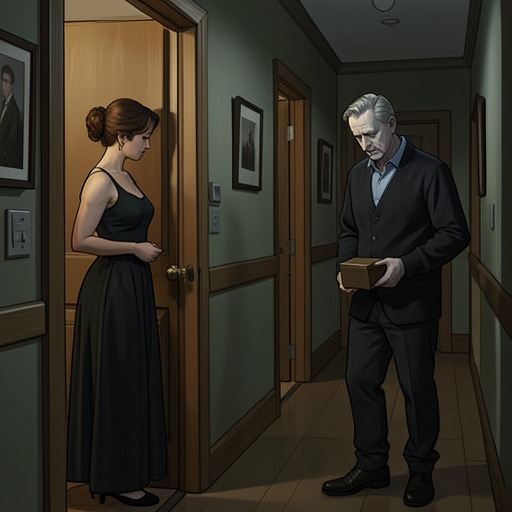
Her condition is precise: they cannot be together until William works through his feelings about Julia. Diana makes clear that she is not Julia, yet warns that unresolved pain may cause him to treat her as if she were. She therefore chooses separation despite loving him and despite not wanting to lose him. The boundary is not a rejection of William's feelings; it is a refusal to let those feelings override the risk he poses to their relationship while his past remains emotionally active. Her kiss on his forehead and her opening of the door frame the decision as both tenderness and departure.
The Trauma Behind the Condition
William's history gives Diana's boundary its foundation. He explains that Julia became pregnant, that he stayed with her, and that he learned at a twelve-week medical appointment that the child was not his. The timing proved impossible because he had been away at a conference during the possible period of conception. Rather than confront Julia in front of the doctor who would oversee her pregnancy, he waited until they left the office, packed his bags, contacted his lawyer, and never saw her again after the divorce.
Julia first begged him to stay, saying that she had made a mistake and loved him. When he refused, she lashed out and blamed him for not giving her enough attention. William sees this as a repetition of the selfishness he believes had been hidden from him before the marriage. His account makes the betrayal concrete, but it also exposes the incompleteness of his response: he ended the marriage and moved forward without confronting what the experience had done to his capacity for trust.
Diana recognizes why he had difficulty telling her. She can see the brokenness in him and understands that the betrayal was not a minor disappointment. Yet understanding does not become an excuse. She tells him that she is sorry he suffered, while maintaining that his history cannot justify lying to her or allowing the past to govern the present. This distinction is central to the rule: compassion may explain behavior, but it does not erase responsibility for its effects.
Family Models of Abandonment and Repair
The boundary is reinforced by the family histories surrounding both lovers. Diana's mother, Cora Jones, is remembered as deeply self-sacrificing, while her father, Derek Jones, loved her more than life itself. Derek's first marriage to Luna Jones ended after Luna's bipolar disorder and refusal to seek treatment placed strain on the household; after the divorce, Luna left Connor in Derek's care. Connor's experience of maternal abandonment helped make him family-oriented and protective, and after the death of Cora Jones and Derek Jones he compelled Diana back into work when grief had left her unable to function.
William's account of his own mother is strikingly parallel. He says that his parents divorced because his mother did not want children, that she remained until he was ten, and that he hears from her only on his birthday, if she remembers. He lives with the knowledge of a parent who chose distance, while Connor lives with the consequences of a mother who left after illness and family strain. Diana's sensitivity to abandonment is therefore not abstract; it is embedded in the family relationships she has witnessed and depended upon.
William's family also offers Diana's boundary a possible model of repair. During the break, William goes to his parents' Sunday lunch despite wanting to avoid it, partly because his father insists on family commitments and Gloria has helped bring him home. Tara rushes down the walkway and jumps into his arms, while his father pats his back and Gloria hugs him. The guilt and affection stirred by that welcome eventually persuade him to tell them that he and Diana are on a break. Gloria then tells him that he has never properly dealt with what Julia did, having brushed aside the pain instead of facing it. She argues that acknowledging the pain and the wrongdoing is necessary before the love he feels for Diana can become healing rather than another way of evading the wound.
Ethical and Narrative Significance
Diana's rule distinguishes a second chance from a return to the previous arrangement. William's request to start over promises renewed intimacy, but Diana requires more than a declaration of love or a kiss. She requires truthful recognition of the past, responsibility for the harm it caused, and evidence that Julia's betrayal will not be imposed upon her as suspicion. In this sense, reconciliation must rebuild the conditions of trust rather than merely restore the appearance of romance.
The boundary also gives Diana agency within a relationship shaped by unequal pressures. William is connected to the hotel through his authority over Connor's workplace, while Diana's employment is tied to the fragile stability she recovered after bereavement. Her first concealment arises from fear, but her later decision is deliberate and self-protective. She refuses both to be defined by her mistake and to accept the role of a substitute for Julia. By leaving while she still loves William, she makes emotional safety a condition of love rather than its casualty.
The rule's deepest significance lies in its insistence that healing must be witnessed and enacted. Diana listens to William's confession, accepts the truth of his suffering, and still names the danger that remains. Gloria similarly listens to his account and urges him to acknowledge what he has avoided. The resulting structure does not present forgiveness as the disappearance of injury. It presents forgiveness as something that may become possible only after the injured relationship is given facts, accountability, time, and a meaningful change in how the wound is carried.